
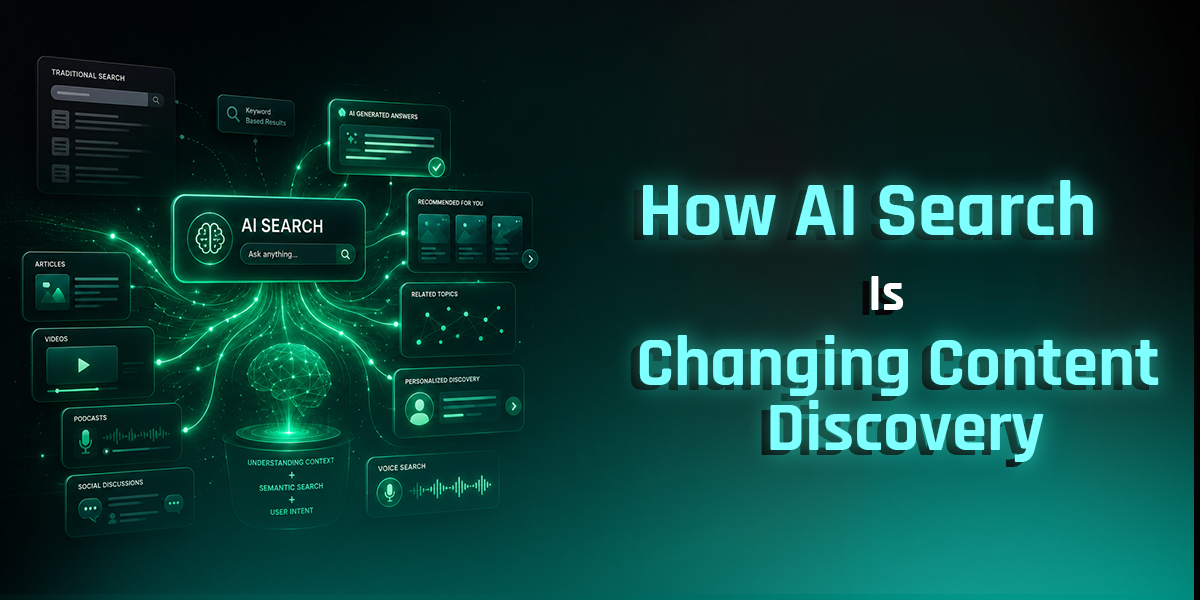
The way people discover content online is evolving rapidly. Traditional search engines once relied heavily on keywords and backlinks to determine which pages should appear in search results. Today, artificial intelligence is reshaping how content is understood, ranked, and delivered to users.
AI-powered search systems focus more on context, intent, and relevance rather than simple keyword matching. This shift is changing how businesses create content and how users interact with information online. As AI search continues to evolve, brands must adapt their content strategies to remain visible and competitive.
Search engines are becoming smarter at understanding the meaning behind queries. Instead of only analyzing exact keywords, AI systems interpret context, user behavior, and relationships between topics.
For example, a user searching for “best strategies to grow online visibility” may receive results related to SEO, branding, or performance marketing—even if those exact words are not present in the content. AI can now connect related concepts and identify the intent behind a search.
This change means businesses must focus on creating meaningful, topic-focused content rather than relying on repetitive keyword usage.
AI-driven search engines aim to provide answers that align closely with what users actually want. Search intent has become one of the most important ranking factors in modern SEO.
Instead of rewarding pages that simply repeat keywords, AI evaluates whether the content genuinely solves a user’s problem or answers a question effectively. This encourages businesses to create deeper, more informative content that provides real value.
Many brands competing with the top digital marketing companies in India are already adapting by building content strategies centered around user intent and topical relevance rather than isolated keyword targeting.
With the growth of AI assistants and voice search, users are searching in a more natural and conversational way. Queries are becoming longer, more specific, and more context-driven.
Rather than typing short phrases like “SEO tips,” users may now search for “how to improve website rankings for local businesses.” AI search systems are designed to interpret these conversational queries more accurately.
This trend is pushing businesses to create content that sounds natural, answers specific questions, and aligns with how real users communicate online.
AI search systems are increasingly rewarding comprehensive and authoritative content. Thin or surface-level articles are less likely to perform well because AI can evaluate the depth and completeness of information more effectively.
Content that covers related subtopics, answers multiple user questions, and demonstrates expertise has a stronger chance of ranking well. This is why topic clusters and topical authority strategies are becoming essential in modern SEO.
Brands focused on delivering the best digital marketing experiences often invest in creating detailed, high-value content that supports long-term authority rather than short-term traffic gains.
AI search is changing not only rankings but also how users discover content. Instead of browsing multiple websites, users increasingly receive summarized answers directly within search interfaces.
This means businesses must optimize content for visibility within AI-generated responses and featured search experiences. Clear structure, semantic relevance, and trustworthy information are becoming more important than traditional ranking tactics alone.
As search evolves, visibility will depend more on content quality and contextual relevance than on simply targeting high-volume keywords.
AI systems are designed to prioritize trustworthy and credible information. Websites that demonstrate expertise, authority, and reliability are more likely to gain visibility in search results.
This is especially important in competitive industries where users seek professional guidance. A skilled digital marketing expert understands that modern SEO is no longer just about ranking pages—it is about building credibility through consistent, high-quality content.
Businesses that focus on educating users and solving problems are better positioned to succeed in AI-driven search environments.
AI search is transforming content discovery by making search engines more intelligent, conversational, and user-focused. Businesses that continue relying on outdated SEO tactics may struggle to maintain visibility as search behavior evolves.
The future of content discovery will depend on relevance, expertise, and the ability to meet user intent effectively. Brands that invest in high-quality, structured, and topic-focused content will be better prepared for the next generation of search.
As AI continues to shape digital experiences, businesses must adapt their strategies to create content that serves both users and intelligent search systems.


© 2023 Copyright damnZgood. All Rights Reserved.




.png)
