
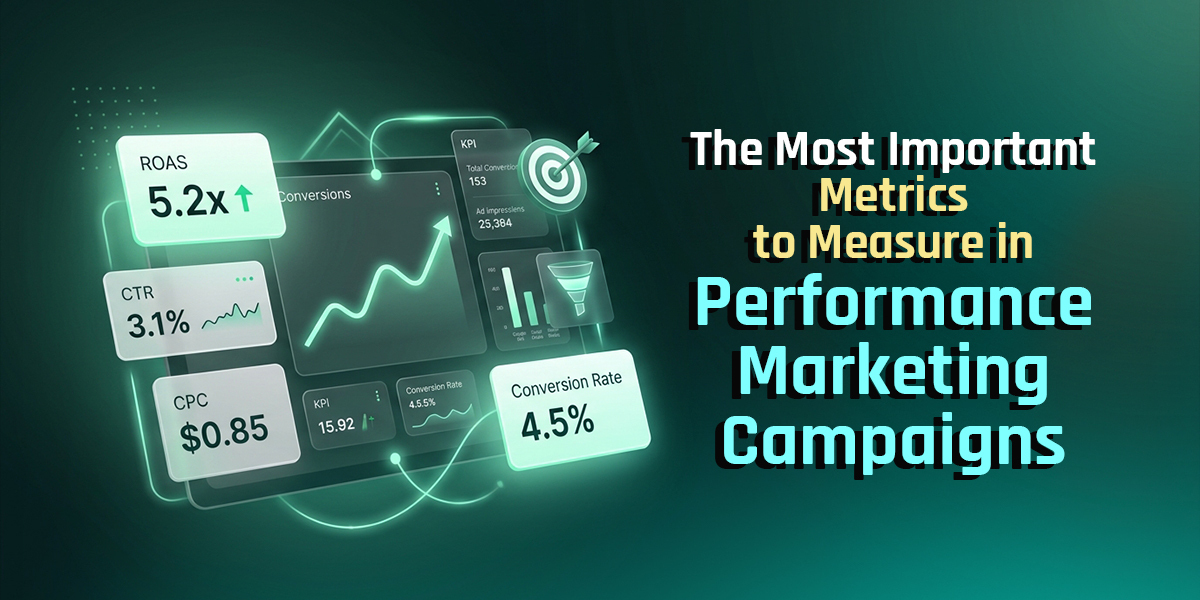
Performance marketing has become a core strategy for businesses aiming to achieve measurable growth. Unlike traditional marketing, it focuses on data-driven results where every click, impression, and conversion can be tracked. However, success in performance marketing doesn’t just depend on running campaigns—it depends on tracking the right metrics.
Understanding which metrics matter helps businesses optimize campaigns, reduce wasted spend, and improve overall return on investment
Metrics provide clarity on how your campaigns are performing. Without proper tracking, businesses risk making decisions based on assumptions rather than real data. Performance marketing is all about measurable outcomes, and metrics act as the foundation for continuous improvement.
Whether you are working on digital marketing and website development or running paid campaigns, tracking performance ensures that every effort contributes to business goals. It allows marketers to identify what works, what doesn’t, and where improvements are needed.
Conversion rate is one of the most critical metrics in performance marketing. It measures the percentage of users who take a desired action, such as filling out a form, making a purchase, or signing up for a service.
A high conversion rate indicates that your campaign and landing page are aligned with user intent. On the other hand, a low conversion rate may signal issues with your messaging, design, or targeting.
Improving conversion rates often requires optimizing landing pages, refining audience targeting, and enhancing user experience.
Cost Per Acquisition (CPA) tells you how much you are spending to acquire a customer. This metric is essential for understanding the efficiency of your campaigns.
Lower CPA means you are getting more value for your marketing budget, while a higher CPA may indicate inefficiencies in targeting or ad performance. Businesses should continuously monitor and optimize campaigns to keep acquisition costs under control.
An experienced e-commerce digital marketing agency often focuses heavily on CPA to ensure that marketing spend translates into profitable results.
Return on Ad Spend (ROAS) measures the revenue generated for every unit of money spent on advertising. It is a direct indicator of how profitable your campaigns are.
A strong ROAS means your campaigns are generating more revenue than they cost, making them sustainable in the long run. If ROAS is low, it may be necessary to revisit your targeting, creatives, or overall strategy.
Tracking ROAS helps businesses scale successful campaigns while minimizing losses from underperforming ones.
Click-Through Rate (CTR) measures how many users click on your ad after seeing it. It reflects how engaging and relevant your ad is to your target audience.
A high CTR indicates that your ad copy and visuals are capturing attention, while a low CTR suggests that your messaging may need improvement. Optimizing headlines, visuals, and targeting can significantly improve CTR.
Using the right digital marketing tools can help analyze user behavior and improve ad performance effectively.
Customer Lifetime Value (CLV) measures the total revenue a business can expect from a customer over time. While many metrics focus on short-term results, CLV provides a long-term perspective on customer relationships.
A higher CLV means that customers continue to engage with your business, leading to sustained revenue. This metric is especially important for businesses aiming to build long-term growth rather than just one-time conversions.
Balancing acquisition costs with lifetime value ensures a sustainable and profitable marketing strategy.
No single metric can define the success of a performance marketing campaign. Instead, businesses need to analyze multiple metrics together to gain a complete picture.
For example, a campaign may have a high CTR but low conversions, indicating a mismatch between ad messaging and landing page experience. Similarly, a low CPA with poor ROAS may still not be profitable.
By combining insights from different metrics, businesses can make informed decisions and continuously optimize their campaigns for better results.
Performance marketing is driven by data, and success depends on tracking the right metrics. From conversion rate and CPA to ROAS and CLV, each metric provides valuable insights into campaign performance.
By focusing on meaningful data rather than vanity metrics, businesses can improve efficiency, increase profitability, and achieve long-term growth. In a competitive digital landscape, understanding and applying these metrics effectively can make a significant difference in overall marketing success.


© 2023 Copyright damnZgood. All Rights Reserved.




.png)
